Showing posts with label Social Studies. Show all posts

How to Teach Self-Awareness

Know Thyself and Know How to Teach It

What does it mean to know oneself? How does one become self-aware? Furthermore, how do you teach it? 


The search for who we are and what makes us “us” is almost a right of passage and one that we may go through several times throughout our lives.  In fact, Socrates believed that self-knowledge is crucial for individual growth. 


I’ll go one step further and say that self-knowledge is crucial for professional growth as well. 


"Stanford rates soft skills like self-awareness as one of the pillars of managerial capabilities that predicts managerial effectiveness and leadership success. It suggests that IQ and technical skills are far less important to leadership success than self-awareness. In a world of unprecedented business complexities, leaders, besides explicit knowledge, need an inner compass of self-awareness to walk the tightrope of leadership.”


Self-awareness can be a challenging topic for young adults because this is the time when they experience so many firsts, including independence and an increase in responsibility. The safety net is just a little farther away. And uncertainty in one’s self is almost certain. 


To spark interest and engage students in my liberal arts classes, I created a series of activities where students reflect on several famous quotes that center around self-awareness, which are all included in the Know Thyself Mega Bundle.


There are four sets of these activities that can be purchased separately, but I bundled them together as well. Each product has three famous quotations including Maya Angelou, Aristotle, and John Jacque Rousseau with striking images and one blank page as well. Students reflect upon the quotations and figure out how it relates to their own lives.


Each set of quotations comes in both print and Google Slides versions,

so you may incorporate them however you want!

This bundle makes it perfect for in-person, blended, or fully remote courses!


Besides the quotations themselves, I have included a brief explanation of each quotation, a link to the questions for students to use interactively through Classroom™ or other online platforms. To help teachers see how it can be implemented, I also included 5 student examples. 


While learning about what philosophers say about self-awareness, students are able to connect to the content in a very authentic way. 


Not only is this product perfect for introductory philosophy courses, but it can be applied to other academic settings and content! Find any character in a book or historical figure who is on a journey of self-discovery or a character that has revelations of who they thought they were and who they discover themselves to be. Off the top of my head, Scout from To Kill a Mockingbird comes to mind. In that summer of luring Boo Radley and Tom Robinson’s trial, Scout discovers more about herself and grapples with the ironic and sometimes backward ways of others’ behaviors. 


And that is just one example! Just think of the many ways this resource could be incorporated into your lessons! 


I sincerely hope you find this resource useful. It has always been a popular activity in my classroom and I know it will effectively engage your students, too! 


HOW I USE IT IN MY CLASSROOM:


During the spring semester I taught 100% online! I uploaded the digital file and had students choose which quotation they wanted to work with. After they completed the assignment, I reviewed some of the quotations, and their authors, and then I invited students to share their thoughts with the class during GOOGLE MEET. This assignment is now one of my favorites - I cannot believe the responses I get. If we ever get back to normal, you can print and complete this as an in-class assignment or go the digital route!


IT IS NOT INCLUDED IN THE BUNDLE

If you have any questions about any of my products, please leave me a comment! 

Thanks for visiting!


Subscribe

* indicates required
Email Format


0

Using Major Court Cases to Teach Social Justice


Using Major Court Cases to

Teach Social Justice


Social justice, or rather social injustice, has been the topic on every news channel, website, and everywhere on social media. And for good reason. Recent events surrounding the many deaths of black men and women at the hands of white police officers and the protests calling for action have brought to light a myriad of issues, chief among them being systemic racism. 

However appalling and incomprehensible, systemic racism is not new and is no longer lurking in the shadows. Students are reading about it, hearing about it, and adding to the discussion. Some students are even living it. This makes it all the more imperative that social justice and social injustice be a significant part of the curriculum in today’s schools to give students the tools they need to think critically about and participate in the discourse. 

Make no mistake, injustice is everywhere and perpetuated by every institution, especially the legal system. This is why it is crucial to study court cases that highlight systemic racism and help shape society’s response to it. 

Every semester I teach at least two courses on social justice, and there never seems to be enough time in the term to address all of the nuances that the subject entails. A cornerstone in these courses is the study and analysis of court cases pivotal in the fight for social justice.  

The topics and areas of discussion (and debate) tantamount to social justice include individual versus collective rights, intention versus outcome, categorical versus hypothetical imperatives, and law versus justice, all of which address the social injustice perpetrated through the legal system. I recommend teaching the following cases: 
  • The Scottsboro Boys
  • Mississippi Burning 
  • Brown vs Board of Education 
  • The OJ Simpson Trial
  • The Leo Frank Trial
  • Emmett Till
  • The Rodney King assault case
  • Rubin "Hurricane" Carter case
  • Amistad Trials
  • Dred Scott v. Sanford
  • Massie Trials
  • LAPD (King Beating)
  • George Zimmerman (Trayvon Martin) Trial 

In my classes I provide the philosophical background of these cases to help shape the debate over the topics mentioned above. To achieve the level of critical thinking, discussion, and debate, while keeping students engaged and tuned in, I have students create infographics and posters of these court cases. 

Infographics and posters are an excellent way to engage students at the top levels of Bloom’s Taxonomy (analyze, evaluate, create). My students really enjoy these activities because they can be used to review for an exam, prepare for a debate, and can even be a great alternative to essays! 

These two assignments are perfect for online learning! Your students can follow the rubric and create their poster or infographic online and then submit through Google Classroom! I find that showing examples helps a tremendous amount, so I now do this part through Google Meet. I share my screen and walk through the steps and the sample projects.

I have an Infographic assignment I use when teaching the Scottsboro Boys trials, but you can do this activity with any of the trials mentioned above. Here is what is included:
  • A rubric that shows students what is expected in their finished product. It provides a colorful guide in the form of an Infographic created from Easelly.
  • Same guide in a black and white printable format.
  • Instructions for students as a PDF.
  • Instructions that I give my own students - in a partially editable interactive format using Google Slides
  • Instructions for teachers.
  • Tips for teachers and students.
  • Student examples
Here is an example from the Massie Trials:


Here is what is included in my Poster Project on famous trials: 
  • Two rubrics: one that includes philosophy and one that does not
  • Editable student instructions
  • Instructions for teachers
  • Example websites for students to create their posters
  • Tips for students and teachers
  • Student examples
  • Example citation page

Here is an example of a poster when studying the Rubin "Hurricane" Carter case:

Other products related to social injustice: 


If you have any questions about any of my products, please leave me a comment! 

Thanks for visiting!


Subscribe

* indicates required
Email Format


0

Is Closure in the Purview of the Law?


Is Closure in the Purview of the Law? 

In other words, can the legal system provide closure to victims and/or victims’ families? That is the question addressed in my Emmett Till Dilemma One Sheet activity. 

Who Was Emmett Till? 

Emmett Till, a Chicago native, was visiting his family in Money, Mississippi in August 1955, when a seemingly harmless trip to the grocery store to buy gum lead to his death. There are conflicting reports about what exactly happened in that grocery store, but it involved the white cashier Carolyn Bryant reporting to her husband, Roy Bryant, that Till made lewd gestures, whistled at her, and even grabbed her. Bryant and his brother-in-law J.W. Milam drove to where Till was staying at his uncle’s house and forced him into their car by gunpoint. 


Three days later, Till’s mutilated body was found in the Tallahatchie River. He was badly beaten, his head was smashed, he had been shot, and barbed wire was wrapped around his neck attached to a cotton gin fan. 


The two men were charged with murder but were acquitted by an all-white jury. After the trial, both men admitted to killing Till, but could not be charged again because of double jeopardy.


Emmett Till’s Case Today

The case of the murder of Emmett Till was reopened in 2018 as part of the Emmett Till Unsolved Civil Rights Crime Act of 2007 that works with the federal Justice Department to investigate unsolved civil rights related deaths prior to 1970.  


According to Time, “A reinvestigation of this case could be a rare chance to bring some closure to one of the most vivid examples of racial violence in the South, from a moment when the U.S. was on the brink of the Civil Rights Era.”

The question of closure is at the heart of the Emmett Till Dilemma One Sheet Activity. 


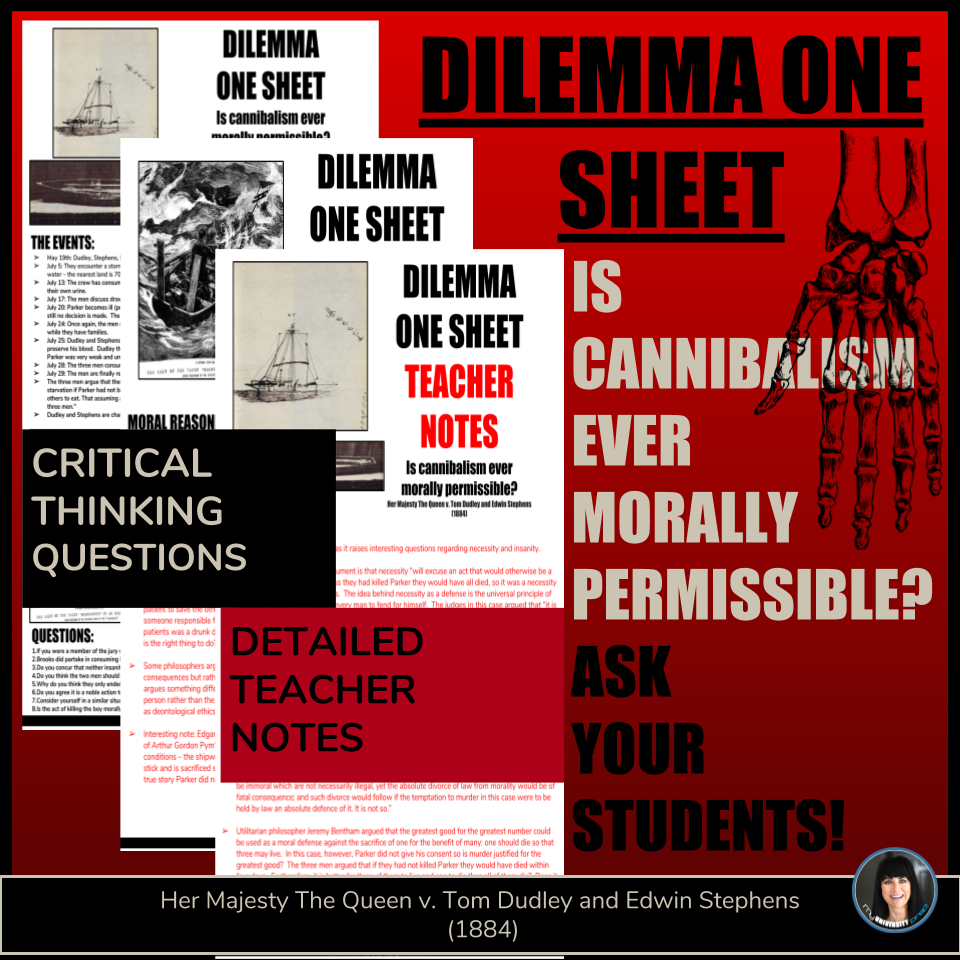
Dilemma One Sheets are single-page documents that contain information, events, and discussion questions about a particularly interesting and relevant case, such as whether the justice system can offer closure, that introduces students to philosophy, ethics, law, and justice, and helps them engage in critical reasoning. 


Dilemma One Sheets can fit virtually in every curricular area and can be employed in myriad ways. Use them as bell ringers to grab your students’ attention and start the class in a fun and engaging way! 


Or, use it to pair with a piece of literature you are reading in English class. For example, the Emmett Till Dilemma One Sheet Activity can be a great addition to a discussion of The Hate U Give.


How does it work? 

Fairly simply, actually. Students are given a dilemma one sheet with a question to spark intrigue and evoke responses, possibly even conflicting ones. The one-sheets are single sheet documents that include a list of important events surrounding the case, information on the trial and/or litigation, discussion questions to help keep the students engaged, and detailed teacher notes as well. This makes implementing these into your lesson plans simple and virtually hassle-free – every teacher’s dream! 


If you have been thinking about how and when to address issues of rioting, protesting, and racism in your classroom, know that it is always the right time to incorporate more content related to the fight for equality among all intersections of humanity. 


It is my sincere hope that you are able to find this product helpful as you navigate how to teach in response to systemic racism and power, and connect it back to our not-so-distant past. 


If you’d like to read my thoughts on how we, as teachers, can respond to this, visit here. 


Stay Safe. Stay Informed. 

Thanks for visiting!


Subscribe

* indicates required
Email Format

0

LISTEN


LISTEN


So far in 2020, the world has experienced not only a deadly global pandemic drastically changing every facet of our lives, but also rioting and protesting that come near to mimicking those of the Civil Rights Movement, proving that we have a lot more work to do. 


However, as unbelievable and shocking as these events are, they aren’t firsts for us, by far. The world experienced the Spanish flu epidemic in 1918, and the Civil Rights Movement from 1954 to 1968, and although we think we have come far as a society, recent riots over the death of George Floyd and others across the nation, show we haven’t come far enough. 


We are now living in a time where trust is at an all-time low. We struggle to trust those in the grocery store not wearing a mask. We think, Are they going to make me sick? Could I then get my family sick? We struggle to trust those in power to lead us and keep us informed with accurate information and to recommend courses of action. 


And now, cities are burning. Anger, frustration, and sorrow run in our veins. There is outrage at the lack of care for human life (recently, George Floyd and Breonna Taylor). BIPOC (Black Indigenous and People of Color) have asked, pleaded even, for people to listen, and their pleas have fallen on deaf ears. 


FIRST WE NEED TO LISTEN!


How do we as teachers respond to the voices? Not addressing these issues in the classroom is doing students a grave disservice. We must address them because this is what they are reading about and talking about when not in class. 


You’ve likely heard or even said, “I can’t wait until things go back to normal.” For many, that may be true. But first, let's review: the "normal" before the pandemic and rioting was not working. It was not sustainable. It was not acceptable. 


Change is uncomfortable. Looking at and learning about this country’s past, especially the ugliest parts, is uncomfortable, which is what it’s supposed to be. 


History textbooks tend to gloss over (or whitewash), and sometimes skip over entirely, these ugly parts of our past, such as the Tulsa Race Riots, the slaying of Emmett Till, and pretty much anything involving Native and Indigenous Peoples.


And it’s not just the South that has a sordid history with systemic racism, bigotry, and discrimination. It’s prevalent everywhere, even in the Midwest, supposedly with the friendliest demeanor and neighborly decorum. 


If we have learned anything from history, it's that history repeats itself. And will continue to do so until we educate ourselves, and our youth, and never cease to do so to ensure these happenings will be erased from our inevitable future. 


So how do we do that, exactly? 


One way is to ensure that representation in the content taught in all subjects is more equal. Students need to read more about the contributions of black scientists, historians, generals, public servants, mathematicians, artists, writers, composers, engineers, musicians, chefs, etc. And not just black individuals, but people who are BIPOC. 


It is not an easy task, addressing the conflicts our students see and experience every day. But it’s important and necessary work. 


If you have any questions about any of my products, please leave me a comment! 

Thanks for visiting!


Subscribe

* indicates required
Email Format

0

Dilemma One Sheet #2

Dilemma One Sheet #2

Is Killing One Child to Save Another Morally Permissible?

Is killing one child to save another morally permissible? We know murder is wrong, but what if it is to save another life? This is one tough question the parents of Jodie and Mary must face in the England and Wales Court of Appeal Decision.

What is right is not always legal, and what is legal is not always right. This is an important topic discussed in classrooms of all subjects, including literature, ethics, and law studies courses, and one addressed in the second of 11 Dilemma One Sheet activities available for teachers.

Jodie and Mary


Imagine you find out the twins you (or your partner) are carrying are actually conjoined, meaning connected by tissue and/or organ. Your daughters each have their own brain, heart, lungs, and other vital organs, but separating them will result in the death of the weaker twin, whom you’ve named Mary. Jodie and Mary share a major artery in the lower abdomen that circulates oxygenated blood from Jodie’s heart to Mary’s body.


The doctors recommend terminating the pregnancy, but your Catholic faith guides you to refuse. Instead, you deliver the twins but now must make the hardest decision of your life. Jodie’s heart will fail in a few short months because it cannot keep up with supplying oxygenated blood to both bodies. The doctors recommend separating the twins, but that would result in Mary’s death. Without the surgery, both will die.  


This certainly is a dilemma!


Jodie and Mary’s parents refuse to separate them citing that it is God’s will that they were born, and, therefore, it’s God’s will that they die. Doctors disagree with the parents’ decision and take steps to intervene. 

What will the courts decide? What will the parents do next? Where does medical law, family law, and criminal law intersect? 

All of these questions are addressed in Dilemma Two, and will give your students the opportunity to critically reason, discuss, and engage with each other!

What are Dilemma One Sheets?


Dilemma One Sheets are single-page documents that contain information, events, and discussion questions about a particularly interesting case, such as the role of courts in family medical decisions, that introduce students to philosophy, ethics, law, and justice, and helps them engage in critical reasoning. 

Dilemma One Sheets can fit virtually in every curricular area and can be employed in myriad ways. Use them as bell ringers to grab your students’ attention and start the class in a fun and engaging way! 

Other ideas for inclusion into the curriculum are group discussion, seminar, debate prep, even writing instruction for academia! Instead of having students complete busy work while a substitute is in the classroom, use these to keep kids engaged and focused, even while you’re away!

Dilemma Two would also make a fantastic pairing with the many movies and books: Sophie’s Choice, My Sister’s Keeper, The Hunger Games trilogy, and The Golden Compass series.

How does it work?

Fairly simply, actually. Students are given a dilemma one sheet with a question to spark intrigue and evoke responses, possibly even conflicting ones. The one-sheets are single sheet documents that include a list of important events surrounding the case, information on the trial and/or litigation, discussion questions to help keep the students engaged, and detailed teacher notes as well. This makes implementing these into your lesson plans simple and virtually hassle-free – every teacher’s dream!

DILEMMA ONE SHEET #1

Whether you’re looking for simple activities to supplement your lessons, bell-ringers, or a resource to teach the art of discussion in an academic setting, Dilemma One Sheets are a perfect fit for your classroom. Be sure to leave feedback and let me know how you incorporate these into your classroom. I love hearing your ideas! 


Thanks for visiting!


Subscribe

* indicates required
Email Format

0